 Tajul Furqan

You read the advice: repeat each ayah 20 times. So you did. Twenty times, eyes on the page, lips moving, counting on your fingers.
Then you closed the Mushaf and tried to say it back. Nothing. Just the first two words and a fog.
If you've ever asked how many times to repeat an ayah before it sticks, here's the honest answer: the number was never the point. You don't need a count. You need a test.
How Many Times to Repeat an Ayah? Why the Magic Number Misleads
Search the question and you'll get a neat range. Five times. Ten. Twenty. Some say forty for a new page.
Those numbers aren't wrong exactly. They're rough averages from people who've done this for years. But an average tells you nothing about the ayah in front of you, tonight, with your tired brain.
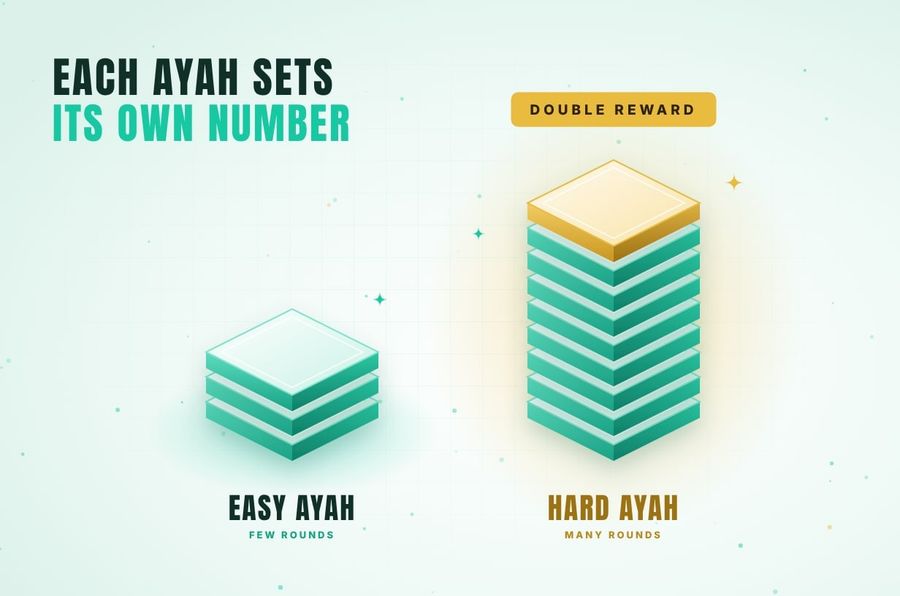
A short ayah you've heard in Taraweeh a hundred times might be yours after three rounds. A long one full of names and unfamiliar words might need thirty. Same reader, same evening, completely different number.
So a fixed count does two quiet kinds of damage. On easy ayat, you waste time grinding reps you didn't need. On hard ones, you hit twenty, tick the box, and move on with an ayah that was never really yours.
Then the next morning it's gone, and you blame your memory. Your memory was fine. The count lied to you.
Twenty Reps While Looking Is Not the Same as Knowing It
Here's the trap most of us fall into. We repeat with our eyes on the page the whole time.
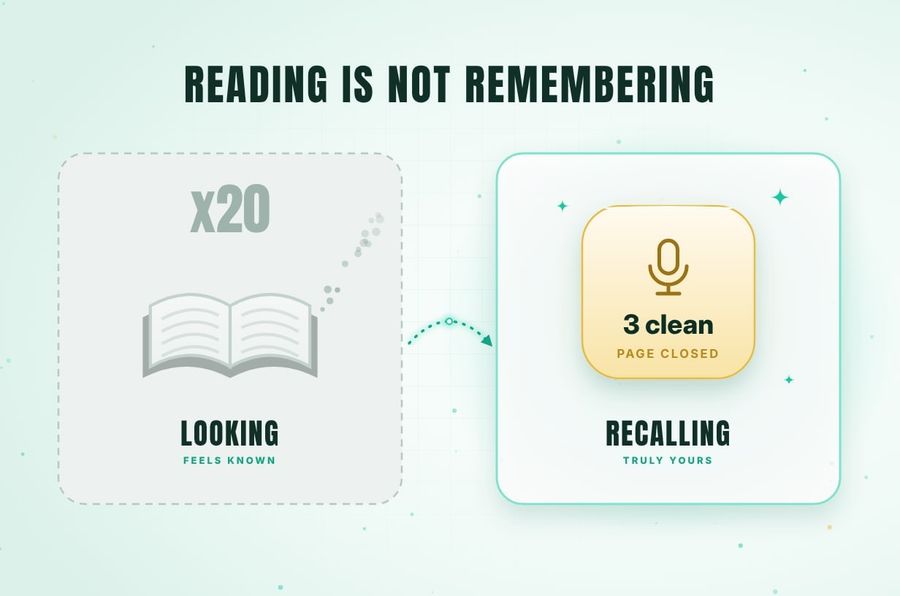
Reading an ayah twenty times trains you to read it. It feels familiar, smooth, almost easy. That smoothness feels like memory, but it's mostly recognition. The page is doing the remembering for you.
You can see this in your own life. You've passed the same shop sign every day for years, and you still couldn't draw it from memory. Seeing something often isn't the same as being able to bring it back.
That's also why you can recite song lyrics you never tried to learn, while a page you repeated last week slips away. The difference isn't effort. We look at it more in why you remember song lyrics but forget Quran verses.
So repetition isn't the enemy. Repetition without ever looking away is.
The Test That Tells You an Ayah Is Really Yours
Swap the counter for three simple moves: look, then recall, then join.
Look. Read the ayah a few times with full attention, out loud, following each word. Listen to a Qari you trust if it helps. A handful of rounds is usually enough here.
Recall. Now cover the page or close your eyes and say it from memory. Not mumbled, not half. The whole ayah, clearly, at a normal pace. If you stumble, peek at only the word you lost, then cover it and start again from the beginning.
Keep going until you can recite it cleanly from memory three times in a row. That's your finish line, not a number someone else picked.
Then prove it later. Move on to the next ayah, and when you come back a few minutes later, recite the first one cold, without a glance. If it comes out whole, it's yours for today. If it doesn't, it wasn't finished, and that's useful to know now rather than tomorrow.
Join comes last. Once two ayat pass the test, you recite them together so they connect. That linking step deserves its own post, so we'll leave it there.
Harder Ayat Need More Rounds, and That's Not a Failure
Some ayat will pass the test in five minutes. Others will fight you for half an hour. That isn't a sign you're slow. It's a sign the ayah is harder.
Long ayat, unfamiliar words, and ayat that look almost identical to others all need more rounds. If similar ayat keep swapping places in your head, the fix is a little different, and we cover it in stop mixing up similar ayat in your Hifz.
And the struggle itself is not wasted. The Prophet (peace be upon him) said that the one who recites the Quran and masters it by heart will be with the noble righteous scribes, and the one who exerts himself to learn it and recites it with great difficulty will have a double reward (Sahih al-Bukhari 4937, sahih).
Double. For the hard ayah you had to repeat thirty times. The difficulty is counted.
So stop comparing your number with anyone else's. Let the test decide when an ayah is done, and let the extra rounds be what they are: extra reward.
Try It Tonight on One Ayah
Pick the next ayah you're working on. Read it with attention a few times. Then cover it and recite it from memory, three clean times in a row. Move on, come back, and recite it cold.
Don't count the rounds. Notice what made it stick and where you stumbled. That's the information a number could never give you.
Repetition is one tool among several. If you want to see how it fits with listening, understanding and keeping what you've learned, the bigger picture is in these Quran memorization techniques for memorizing faster and keeping it. The full step by step system, with printable sheets and a plan, lives in The Self-Hifz Blueprint.
May Allah make every round you repeat heavy on your scales, and make His Book easy on your tongue and firm in your heart.
Learn Every Technique in The Self-Hifz Blueprint
This article is part of our Core Memorization Techniques series. For the full picture, read Quran Memorization Techniques: How to Memorize Faster and Keep It.
The Self-Hifz Blueprint is our step-by-step guide to memorizing the Quran by yourself, at home, at your own pace. Chapter 8, The Repetition Method, covers this in full: how many times is enough, and how to know a line is yours.
Each technique comes with clear steps you can use in your next session, and a simple way to check that it is working.
Get The Self-Hifz Blueprint and start your next session with a clear plan.