 Tajul Furqan

You memorized Surah Al-Mulk as a child from one worn copy. Twenty years later you open a different Mushaf on your phone, and the words are all there, but the page feels like someone else's house.
That small jolt is the real answer to the question of the best mushaf for Hifz. The best one is the one you'll still be holding on your last page.
Why the page itself is part of what you memorize
When you memorize, you don't only store words. You store where they sit. Top of the right-hand page. Third line from the bottom. The ayah that wraps onto the next line.
Ask a hafiz how they find their place in the middle of a long surah, and many will describe the page before they describe the words. That page picture runs quietly underneath your recitation like a second track.
Adults lean on structure like this more than children do, which is part of why memorizing Quran feels harder as an adult. A fixed page is structure you get for free.
Using the page as a deliberate memory map is its own technique, and we cover it separately. For now, hold on to one idea. The layout isn't packaging. It's part of what you're storing.
15-line Madani or 15-line Indo-Pak: which is the best mushaf for Hifz?
For an adult starting or restarting Hifz, the honest shortlist has two options. Both have 15 lines on every page. And the editions printed for memorizers are laid out so that each page ends at the end of an ayah.
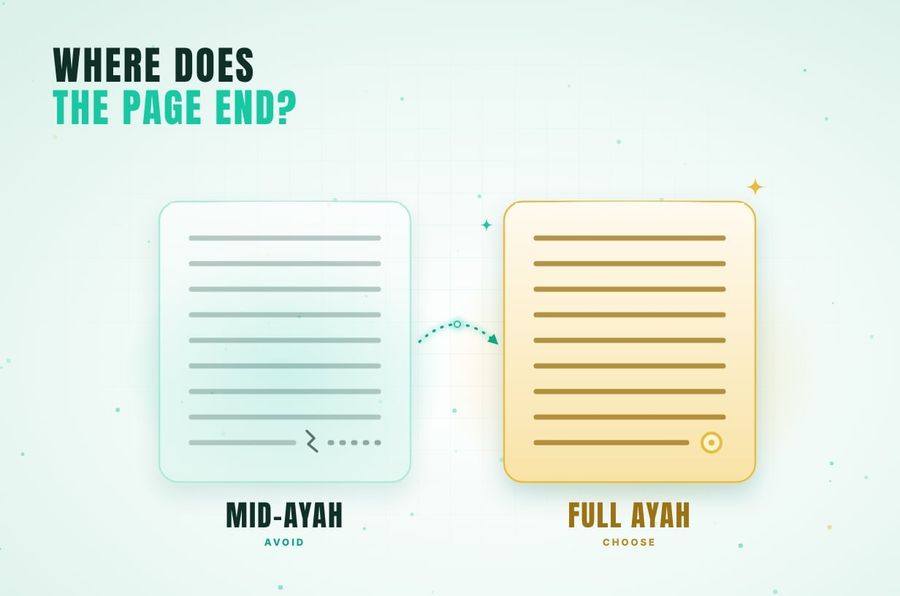
Why does that matter so much? A page that ends in the middle of an ayah splits one sentence across a page turn. Your new lesson stops halfway through a thought, and your memory files the break as if it belonged there.
The 15-line Madani Mushaf is the Uthmani script printed by the King Fahd Complex in Madinah, 604 pages. It's the layout most Quran apps can show page for page, so it's the easiest to match on a screen.
The 15-line Indo-Pak Mushaf uses the South Asian script, with fuller vowel marks and a heavier, rounder hand. Many hifz classes in India, Pakistan and UK masjids use it. Its page breaks are different from the Madani's, so the two are not interchangeable.
So which one? Usually, the script you first learned to read in. If your Juz Amma lives in your memory in Indo-Pak, your eyes already know those shapes. If you read Uthmani script fluently, go Madani. Neither is more correct. Same Quran, same words, different page.
Before you buy, flip to five random pages and read the last line of each. If every page ends on a complete ayah, it's a memorizer's edition.
What switching your Mushaf quietly costs you
Switching feels harmless. The words are the same, after all.
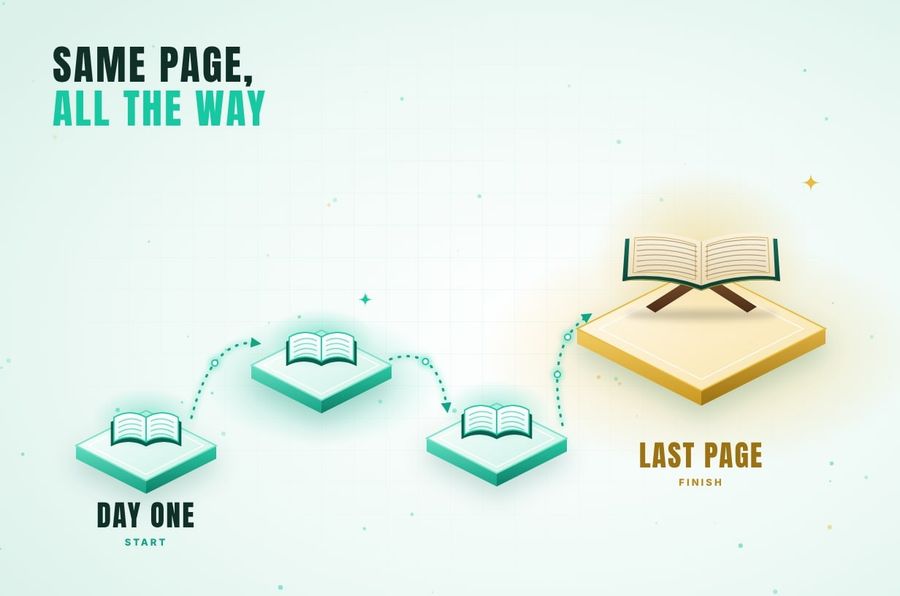
But every page you've memorized carries its picture. Change the edition and the pictures stop matching. Line breaks move. The ayah that sat at the top of a page now sits halfway down. Your recitation stumbles exactly where the old page used to turn.
You don't lose the words. You lose the scaffolding that held them, and you pay to rebuild it on every page you already know.
The Prophet (peace be upon him) said, "The example of the person who knows the Qur'an by heart is like the owner of tied camels. If he keeps them tied, he will control them, but if he releases them, they will run away" (Sahih al-Bukhari 5031, sahih). One Mushaf, used every day, is one of the simplest knots you can tie.
This matters most if you're coming back. If you can find the same edition you memorized from as a child, that may be the best mushaf for Hifz you'll ever own, because part of it is already inside you.
Can you use an app instead of a print copy?
Yes, with one condition. The app's page has to match your print copy, page for page.
Many apps scroll, or reflow the text to fit your screen, or shift the line breaks when you change the font size. That's a third layout, and your brain will try to learn that one too.
Before an app touches your Hifz, check three things:
- It shows fixed pages, not a scrolling feed.
- It's set to the same edition as your print copy, Madani 15-line or Indo-Pak 15-line.
- A few random pages start and end on exactly the same ayat as your paper Mushaf.
If it passes, use it on the commute or in the queue at work. If it fails, keep it for reading and keep your Hifz on paper.
Choose once, before day one
Most people pick their Mushaf by accident. Whatever is on the shelf. Then they switch when they travel, or when a beautiful copy arrives as a gift.
Make it a decision instead, and make it before your next new line. Pick the edition. Buy the one copy you'll use every day. If you want a spare for the office or the car, buy the identical edition, not a nicer one.
Write the edition's name inside the front cover and in your phone's notes. From today, that's the only layout your Hifz will be memorized from.
It sounds small next to everything else you're juggling. But if you're memorizing the Quran as an adult, small fixed decisions like this are what keep a busy life from shaking your progress loose. In The Self-Hifz Blueprint this gets a whole chapter, One Mushaf, Every Day, because it costs nothing and protects every page.
Your one step for today: take the Mushaf you plan to use and check the last line on five pages. If they all end on a full ayah, it's yours. Keep it close.
May Allah make it the copy you finish your Hifz in, and put barakah in every page you learn from it.
Start on the Right Foot With The Self-Hifz Blueprint
This article is part of our Before You Begin series. For the full picture, read Memorize Quran as an Adult: It Is Not Too Late After 30.
The Self-Hifz Blueprint is our step-by-step guide to memorizing the Quran by yourself, at home, at your own pace. Chapter 6, One Mushaf, Every Day, covers this in full: the most underrated technique in the book.
It also walks you through planning your goal, your pace and your finish date before day one, so you start with a clear path.
Not ready for the full guide yet? Start with the free Self-Hifz Quick Start, a short illustrated guide to your first week.
Get The Self-Hifz Blueprint and start your next session with a clear plan.