 Tajul Furqan

You can recite ayah 4 perfectly. You can recite ayah 5 perfectly. Put them together and your mouth stops dead in the gap, like a car stalling at a junction.
If you've been searching for how to connect ayat when memorizing, here's the honest answer. The ayat aren't the problem. The join between them is, and almost nobody practises the join.
Why You Know Every Ayah but Stall Between Them
When you memorize an ayah, you rehearse it from its first word to its last. Then you stop. You breathe, look down, and start the next one fresh.
So your memory learns exactly what you trained. A clean start and a full stop. The last words of ayah 4 were never introduced to the first words of ayah 5. They've never met.
That's why the stall always happens in the same place. Not in the middle of an ayah, where the words have run in sequence dozens of times. At the edge, where they never did.
Think about a song you haven't heard in years. You can still carry on from any line, because every line was always heard running into the next one. That chaining is a big part of why song lyrics stick while Quran verses slip, and you can build the same chains on purpose.
There's also a limit on how much your mind can juggle. Psychologists George Miller (1956) and Nelson Cowan (2001) showed that working memory holds only a few chunks at once, about four. Two separate ayat plus a cold restart between them is heavy. Two ayat welded into one chunk is light.
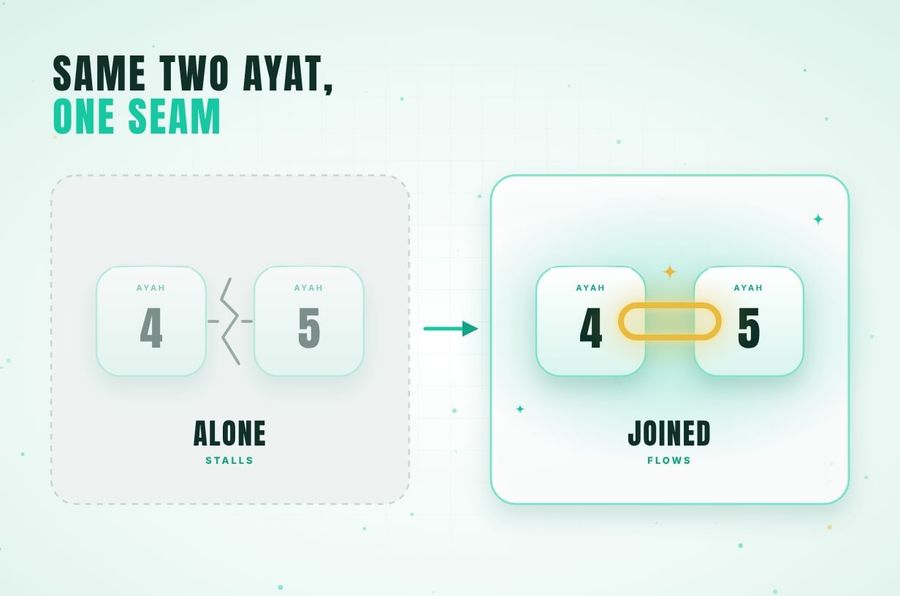
Never Memorize an Ayah Alone
The fix starts before the seam even exists. From today, no ayah counts as finished until it's attached to the one before it.
An ayah you can only recite on its own isn't really part of your Hifz yet. It's a loose bead. It becomes yours once it's threaded onto the string.
This changes what done means. Done isn't ayah 5 coming out clean by itself. Done is running from ayah 4 into ayah 5 with no pause, no peek and no little gasp of searching.
Yes, it feels slower at first. You'll want to bank the new ayah and move on. But ten minutes of threading today saves you an hour of untangling next week.
How to Connect Ayat When Memorizing: Drill the Seam on Its Own
Here's the heart of it. Pull the join out and practise it like a tiny verse of its own.
Take the last three or four words of the ayah you know. Add the first three or four words of the next one. That short phrase crossing the boundary is your seam drill.
- Say the seam aloud, the end of ayah 4 straight into the start of ayah 5, in one breath if you can.
- Cover the page and say it again. If you hesitate at the boundary, look once, then try again from memory.
- Once it flows, widen it. Run the full ayah 4 into the first half of ayah 5.
- Then recite the whole pair, start to finish, with the page closed.
Saying it out loud matters. MacLeod and colleagues (2010) found that words spoken aloud are remembered better than words read silently, which they called the production effect. Your tongue learns the turn as much as your mind does.
Covering the page matters too, because pulling the seam out of memory is what makes it hold. If you're wondering how many rounds that takes, it's better to stop counting and start testing. The seam is simply where you test first.
Start From What You Know and Run Into the New Part
When you add a new ayah, don't begin your practice at the new ayah. Start one or two ayat back, on ground you already own, and let your momentum carry you over the edge.
Think of a long jump. Nobody jumps from a standstill. You run up on solid ground, and the take-off happens at speed.
Starting from known ground gives you two wins. You rehearse the older seams again for free, and your memory starts to expect the new ayah as the natural next step instead of a separate task.
If the run breaks at the new seam, don't go back to the top of the page. Go back only to the ayah before the break and run through it again.

Connect the Whole Page Before You Turn It
Each seam you drill is a short weld. The page only becomes one piece when you can recite it from the first line to the last without stopping.
So before you start a new page, run the whole page you're on in one go. Every seam gets tested in its real place, at real speed.
If one join keeps catching, that's your weak link. Drill that seam on its own until it flows, then run the page again. A chain snaps at its weakest link, and so does a page in salah.
Connecting ayat this way is what turns a pile of memorized verses into a page you can actually recite. It sits alongside the other Quran memorization techniques that help you memorize faster and keep it.
And if this feels slow and clumsy at first, take heart. The Prophet said that the one who recites the Quran with great difficulty while exerting himself to learn it will have a double reward (Sahih al-Bukhari 4937, sahih). Every stumble at a seam is counted.
Your one step for today is small. Open the page you're working on, find the seam that always trips you, and drill only that join aloud with the page covered until it flows three times in a row. Then run the whole page once.
May Allah make every ayah you carry flow into the next, and make the Quran light on your tongue and firm in your heart.
Learn Every Technique in The Self-Hifz Blueprint
This article is part of our Core Memorization Techniques series. For the full picture, read Quran Memorization Techniques: How to Memorize Faster and Keep It.
The Self-Hifz Blueprint is our step-by-step guide to memorizing the Quran by yourself, at home, at your own pace. Chapter 10, Linking, covers this in full: connecting ayah to ayah, so a page flows as one.
Each technique comes with clear steps you can use in your next session, and a simple way to check that it is working.
Get The Self-Hifz Blueprint and start your next session with a clear plan.