 Tajul Furqan

You're reciting Al-Baqarah in the car. Smooth, confident, no hesitation. Then you hit a verse you know cold, finish it with the ending from a different surah, and your stomach drops.
You were so sure. That's not forgetting. That's mutashabihat in the Quran, and it trips up almost every hafiz, including people who have recited for decades.
Why Similar Ayat Feel Like Forgetting (But Aren't)
Mutashabihat are verses that look or sound almost identical but differ by one word, one letter or one ending. Your memory of them is usually strong. That's exactly the problem.
When two verses share most of their words, your brain files them as one memory. You recite the first half and it offers whichever ending arrives fastest.
So you didn't fail to memorize. You memorized the shared part twice and the difference zero times.
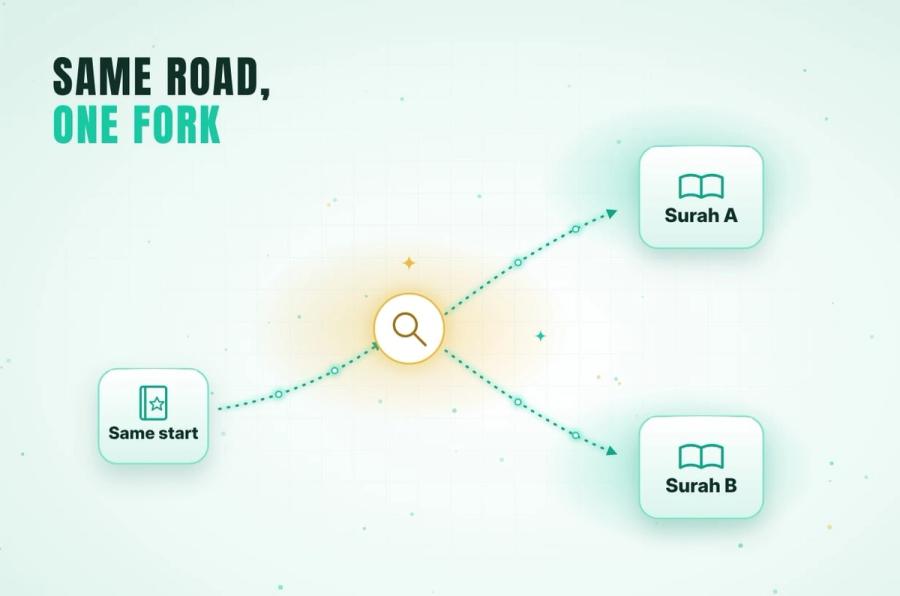
Think of two roads that share the same first mile. You walk it with total confidence, then there's a junction, and nobody put up a sign.
It hits returning adults harder. You recite by yourself, at home, with nobody there to catch the wrong turn, so the mistake quietly sets. If you also feel like everything slips away, read why you keep forgetting what you memorize too.
Stop Drilling the Part You Already Know
Most of us fix a mix-up by reciting the whole passage again. Ten times. That strengthens the shared part, which was never the problem.
Go straight to the fork instead. The fork is the exact word where the two verses split. It's the only thing that deserves your effort.
Take the story of Adam and the tree. It appears in Al-Baqarah and again in Al-A'raf, same scene, with small differences in the wording. Don't re-memorize the story. Memorize the one place where each version turns.
Speed is the other culprit. At full pace you glide straight through the fork without ever seeing it. Slow down three words before the split and say the fork word a little louder, as if you were pointing at it.
Build a Mutashabihat Notebook for Your Quran
Every time you slip, you get free information. Your brain just showed you which pair is weak. Catch it in writing, in three quick steps:
- Write both verses side by side on one page.
- Underline the fork, the word or ending that differs.
- Say out loud why that ending fits that verse. Mercy after forgiveness, power after a warning.
Forks come in a few shapes. Sometimes it's one small word, like a different particle at the start. Sometimes it's a swapped name at the end of the verse. Sometimes it's a single letter that changes the meaning. You don't need the grammar names. You only need to see where it splits.
That last step is the glue. An ending that makes sense in its own context stops floating around, and it stops jumping into the wrong surah.
Keep it small. Five pairs a week is plenty. You're not fixing the whole Quran, you're fixing the places where you actually trip. It's the same idea behind the Sabak, Sabqi, Manzil system: give each weak spot a home in your week.

Revise Look-Alikes Together, Not Apart
Here's the part that feels backwards. Revising similar surahs on different days is how they blur. Put the pair in the same sitting, back to back, and your brain finally sees two things instead of one.
Recite the first verse up to the fork and stop. Recite the second up to its fork and stop. Then finish each one. It takes two minutes.
Then test yourself cold. Start from the opening words with no peeking. If you hesitate, that pair goes straight into the notebook. This also helps when new surahs push the old ones out.
Allah says: "And We have certainly made the Quran easy for remembrance, so is there any who will remember?" (Surah Al-Qamar, 54:17). Ease is promised. Your part is to show up with a method.
Tonight, pick one pair you've mixed up this month. Write it down, underline the fork, and say why each ending belongs. That's the whole action.
May Allah make the Quran easy on your tongue and firm in your heart. Ameen.
Learn Every Technique in The Self-Hifz Blueprint
This article is part of our Core Memorization Techniques series. For the full picture, read Quran Memorization Techniques: How to Memorize Faster and Keep It.
The Self-Hifz Blueprint is our step-by-step guide to memorizing the Quran by yourself, at home, at your own pace. Chapter 16, Similar Verses (Mutashabihat), covers this in full: a simple system for verses that keep mixing up, with a printable notebook.
Each technique comes with clear steps you can use in your next session, and a simple way to check that it is working.
Get The Self-Hifz Blueprint and start your next session with a clear plan.