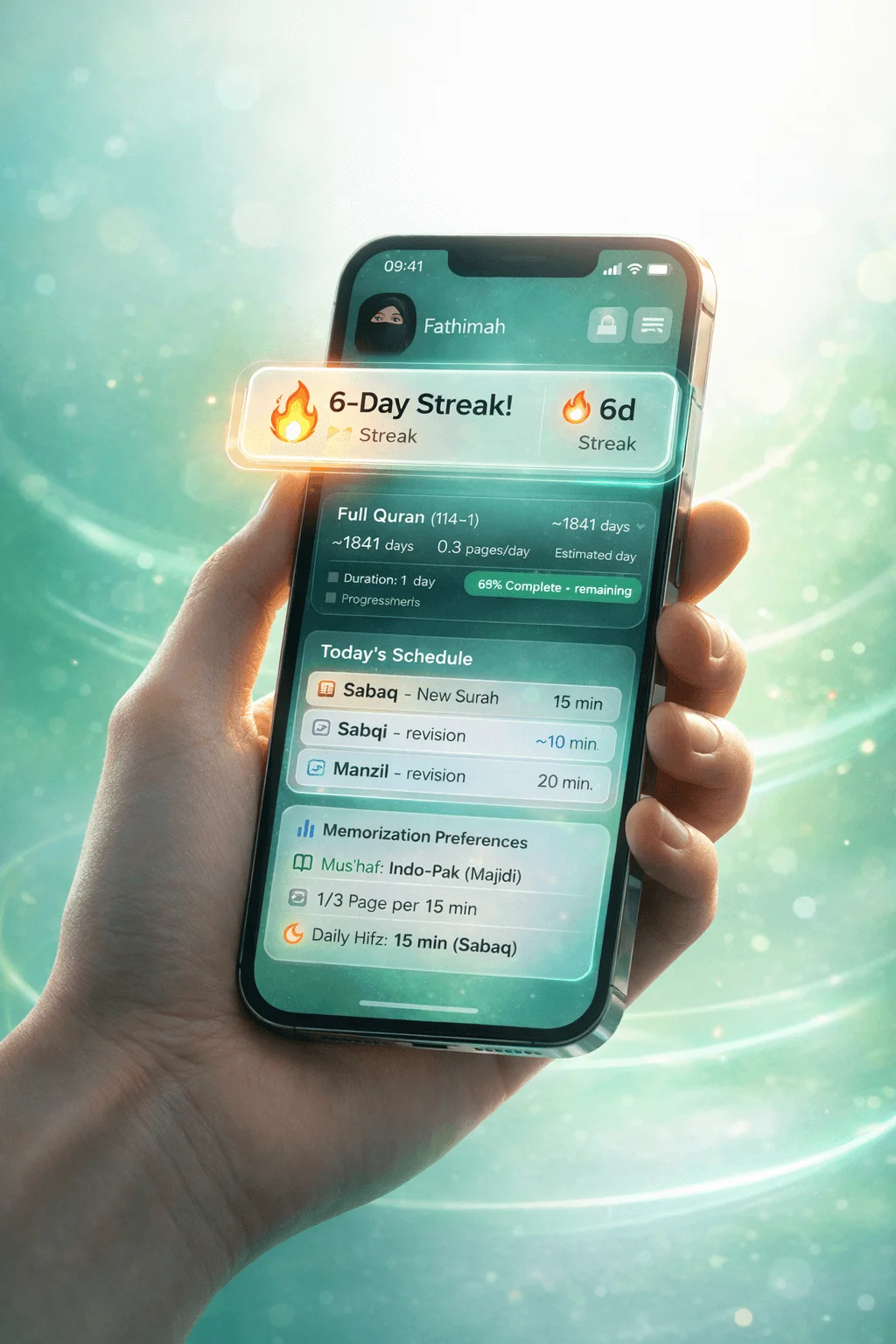
Some days you sit down with the Quran and your brain just will not cooperate. You read the same ayah five times and nothing sticks. You feel like you are trying to write on water. If you are dealing with anxiety, depression, or that thick mental fog that comes with both, you already know this feeling. And you have probably started to wonder whether Hifz is even realistic for you right now. Maybe you have even told yourself to wait until you feel better. I want to be honest with you. Waiting until you feel better can turn into years. And the Quran might actually be part of what gets you there. What Anxiety and Depression Actually Do to Your Memory This is not weakness. This is biology. Anxiety floods your system with cortisol and keeps your brain in a low-grade threat state. Depression slows down the hippocampus, which is the part of the brain most responsible for forming new memories. Brain fog, which often comes with both, is your nervous system running on empty. What this means practically is that your working memory, the mental desk you use to hold new information, gets smaller. Harder to write on. Quicker to wipe clean. So when you sit down for Hifz and nothing sticks, it is not because you are failing. It is because you are fighting a real physiological barrier on top of doing something already difficult. Understanding this matters because it changes how you approach the session. You stop blaming your imaan. You stop concluding that you are not a Quran person. You start adapting instead. The Mindset Shift That Changes Everything Most people approach Hifz with a performance mindset. How much did I get done today? How many lines? How many pages? If the answer feels too small, the session feels like a failure. And when you are already in a fragile mental state, that feeling of failure can keep you away from the Quran for days. The shift you need right now is from performance to presence. The goal is not to hit a target. The goal is to show up and be with the words of Allah. Even five minutes of genuine attention is worth more than an hour of anxious, distracted recitation where your mind is somewhere else entirely. Allah subhanahu wa ta'ala says in the Quran: 'And We have certainly made the Quran easy for remembrance, so is there any who will remember?' (Al-Qamar, 54:17). That ease is a promise from Allah, and it holds even for a mind that feels clouded. Your job is to keep coming back. His job is the rest. If you have been caught in the trap of measuring yourself against others who seem to be flying through juz after juz, read this post on why comparing your Hifz progress is sabotaging you. It will help you cut that comparison habit at the root. Practical Adjustments for a Foggy Mind You do not need a completely different Hifz method. You need a few smart adjustments that account for what your brain is working with right now. Shrink the unit. Instead of trying to memorize a full page or half a page, work with one ayah at a time. Just one. Read it ten times. Close the Mushaf. Say it from memory. Open again. Correct. That is a session. That counts. That is Hifz. Use your voice more than your eyes. When brain fog is heavy, silent reading barely registers. But speaking the words out loud activates a different part of your brain. Recite loudly. Let your mouth help your memory when your mind is struggling to carry the load alone. Lower the bar on new memorization and raise it on revision. When your mental energy is low, new information is the hardest thing to absorb. Revision of what you already know is far more forgiving. Spend 80 percent of your session on what you have and 20 percent on something new. You stay connected. You stay moving. And the forgetting loop does not take hold. Time your sessions for your clearest window. For most people this is right after Fajr, before the day's noise and worry has a chance to build. Your cortisol has already peaked naturally at that hour, and your mind is as fresh as it is going to get. If morning is not possible for you, check out Hifz after work when you are mentally exhausted for real strategies around the evening window. Use the two-minute entry. On the days when even opening the Mushaf feels impossible, commit to just two minutes. Literally two. The two-minute rule for Hifz is not a gimmick. For someone with anxiety or depression, lowering the entry barrier that dramatically can be the difference between touching the Quran that day or not. When the Fog Is a Spiritual Sign Worth Listening To Sometimes what feels like mental fog is also something spiritual trying to surface. The Prophet, salallahu alayhi wa sallam, said: 'The heart gets tarnished like iron rusts.' And the remedy he gave was recitation of Quran and remembrance of death. (Al-Bayhaqi, Shu'ab al-Iman, graded hasan by al-Albani) This is not to say your depression is a punishment or that you are failing in your deen. Not at all. But it is worth sitting with the possibility that the Quran is not something to postpone until after the fog clears. It might be one of the things that helps clear it. If you have been pulling away from the Quran because of guilt or a feeling of unworthiness, that is a very specific trap worth naming. There is a whole post on returning to Quran memorization when guilt is the only thing keeping you away that addresses exactly this. Give Yourself Permission to Go Slow There was a companion of the Prophet salallahu alayhi wa sallam who took twelve years to memorize Surah Al-Baqarah alone. Twelve years. And the scholars praised him for it. Speed was never the point. Consistency and sincerity were. You can read the full story in this post about the companion who took twelve years. If your version of Hifz right now is one ayah a day on the hard days and five on the good ones, that is still Hifz. That is still your name being written among those who carry the Quran. Do not let the pace shame you out of the path. The all-or-nothing mindset is particularly dangerous when mental health is already a struggle. If you recognize that pattern in yourself, take a look at the all-or-nothing mindset silently killing your Hifz. It will name exactly what is going on and help you dismantle it. Your Next Step This Week Do not redesign your whole Hifz system today. Just do this one thing. Tonight, or after Fajr tomorrow, open your Mushaf to a surah you already know well. Read it out loud, slowly, just for the feeling of it. No memorization target. No pressure. Just you and the words. Notice how it feels. That is where you start rebuilding from. HifzBuddy: A Hifz Companion Built for Real Life If anxiety, depression, or brain fog has made Hifz feel too heavy to do alone, you do not have to figure it out by yourself. Whether you are restarting after months away from the Quran, trying to hold on to what you have memorized while life is hard, or finally beginning your journey as an adult, that is exactly why we built HifzBuddy for people like you. HifzBuddy pairs you with a qualified, patient teacher who understands adult learners. No rigid targets. No judgment for slow weeks. Just consistent, structured support that adapts to where you actually are, not where you think you should be. On the days when your mind is foggy and the Quran feels far, having someone waiting for you in a session can be the only thing that keeps the thread going. Give HifzBuddy a try this week and let that thread hold.
 Tajul Furqan