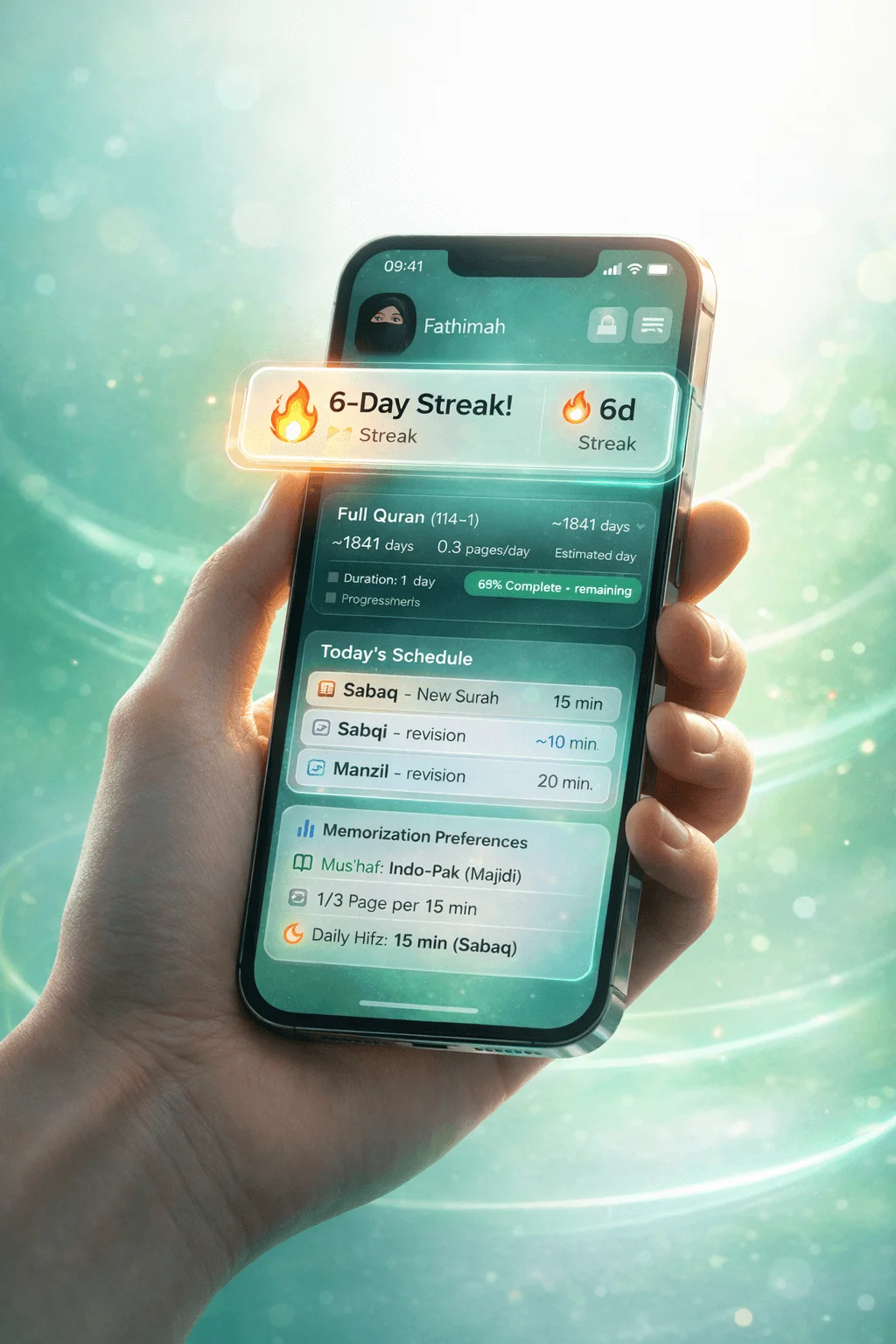
You sat down to watch one episode. Two hours later you were still there, blanket pulled up, phone forgotten, fully locked in. Netflix did not beg you to keep watching. It just made stopping feel harder than continuing. Now think about your Hifz. How many times have you sat down with the Quran, done five minutes, then quietly closed it and picked up your phone? Not because you did not care. Because the habit was not wired right. The difference is not willpower. It is architecture. Netflix spent billions engineering the exact sequence of triggers, rewards, and anticipation loops that make quitting feel like a loss. You can steal that architecture. And you can use it for the Quran. What Netflix Actually Does to Your Brain Netflix does not hook you with good content alone. It hooks you with a dopamine loop. A familiar opening screen. The autoplay countdown. The "Previously on..." recap. Each of these is a cue that tells your brain: something rewarding is about to happen. Your brain releases a small hit of dopamine just in anticipation, before you have even watched a single frame. That anticipation is the secret. Dopamine is not just about pleasure after the fact. It spikes hardest in the moment before the reward. Netflix engineered every second of the pre-show experience to trigger that spike. The result is that sitting down to watch becomes automatic. Your brain craves the ritual before it even gets to the content. Your Hifz routine can have exactly the same wiring. And no, this is not about making the Quran feel like entertainment. It is about understanding how habits actually form in the human brain and using that knowledge to serve the greatest act of worship you will ever do. The Three-Part Loop You Need to Build Every strong habit runs on the same three-part loop: cue, routine, reward. Netflix nails all three. Your Hifz habit needs to do the same. The cue is what triggers the behaviour. For Netflix it is the notification, the sofa, the remote. For your Hifz it needs to be just as specific. Not "after Fajr" as a vague intention, but a locked physical cue. The moment you place your Mushaf on your prayer mat. The moment you put in your earphones. The moment you sit in a specific chair. Habit stacking Hifz means anchoring your memorization session to something you already do every single day without thinking. The routine is the memorization itself. Keep it short to start. You are not building a marathon, you are building a reflex. If you struggle to find the time, you might already know that even twenty minutes a day done consistently beats two hours done randomly. The reward is where most people fail. They finish a session and immediately think about what they forgot or how slow they are going. That is like Netflix ending an episode with a lecture about your screen time. The reward has to feel real. Sit for thirty seconds after your session and just feel the weight of what you just did. You recited the words of Allah. That moment of conscious gratitude is your dopamine anchor. Habit Stacking: The Netflix Autoplay for Your Hifz Autoplay is the most powerful tool Netflix has. You did not choose to watch the next episode. The choice was made for you, invisibly, before the credits finished rolling. Habit stacking works the same way for Hifz. You stack your Hifz session directly onto an existing habit so that one automatically triggers the other. After I pray Fajr, I open my Mushaf. After I make my morning coffee, I recite for ten minutes. After I sit in the car before driving to work, I listen to the surah I am memorizing. The previous habit is your autoplay trigger. You do not decide to do Hifz. Hifz just starts. If your schedule changes depending on the day, you can also use your commute as a built-in trigger. There is a whole approach to memorizing Quran on your commute that removes the need to carve out separate time entirely. The point is that the best Hifz session is the one that starts without you having to negotiate with yourself. The Cliffhanger Trick: Stop in the Middle on Purpose Netflix ends every episode at the worst possible moment. Right when the tension peaks. You do not get resolution. You get a cut to black. And it drives you mad. In a good way. You can use this for Hifz. Stop your session mid-surah, mid-passage, at a point where you have not yet fully nailed the verse you are working on. Not when you are tired or defeated, but right at the moment where you are close. Your brain will keep rehearsing that verse on its own throughout the day. It will itch to close the loop. This is called the Zeigarnik effect, and it is one of the reasons incomplete tasks stick in memory far longer than completed ones. This also connects to why you remember song lyrics but forget Quran verses. Songs repeat their hooks obsessively and leave you with an unresolved craving. Your Hifz sessions should do the same. What to Do When the Loop Breaks Netflix buffers. Life buffers too. You miss a day. Then two. Then suddenly it has been three weeks and the shame of the gap feels bigger than the gap itself. This is where most people quit permanently, not from laziness, but from the weight of restarting. The fix is what habit researchers call the never-miss-twice rule. One missed session is a blip. Two is the beginning of a new habit, the habit of not doing Hifz. The moment you feel the loop breaking, shrink the routine to its smallest possible form. Open the Mushaf. Read one ayah. Close it. The streak is technically alive. And a living streak is infinitely easier to rebuild than a dead one. You can read more about this exact approach in the two-minute rule for Hifz. Allah's Messenger, peace be upon him, said: "Take up good deeds only as much as you are able, for the best deeds are those done regularly even if they are few." (Sunan Ibn Majah, no. 4240, graded Sahih by Al-Albani). Netflix does not ask you to watch a full season every night. It just asks you to press play. Press play. Your Hifz Deserves a System, Not Just Motivation Motivation is the trailer. It gets you excited. But it does not keep you watching past episode three. The system is what does that. A cue you cannot miss. A routine that starts before you have time to resist. A reward that feels real. And a recovery plan for when life interrupts. You already have the knowledge, the drive, and the partial Hifz. What you have been missing is the architecture. Now you have it. Ready to Make Your Hifz Habit Stick? Try HifzBuddy The hardest part of building any habit is not knowing what to do. It is having someone hold the structure with you. That is exactly why we built HifzBuddy for adults like you, people who know how to memorize but need the right environment to make it a daily non-negotiable. If you are restarting after a long break, HifzBuddy gives you a structured re-entry so you are not just opening the Mushaf blindly and hoping for the best. If you are in the middle of your Hifz and need to keep new memorization and revision running together, your teacher will help you manage both without one eating the other. And if you are just getting serious for the first time as an adult, you will have a qualified teacher who meets you exactly where you are, not where a classroom schedule expects you to be. The cue is right here. The next step is one click. Consider giving HifzBuddy a try this week and let the routine build itself around you. May Allah put barakah in your time, ease in your memorization, and make the Quran the light of your life in this world and the next. Ameen.
 Tajul Furqan