 Tajul Furqan

You used to know it. You could recite it in salah, in the car, before sleep. And now you open the mushaf and the words that once lived in your chest feel like they belong to someone else.
That feeling is one of the most painful things a Muslim can carry. Not because you forgot some text, but because you know what it meant. You know what you had.
But here is what I want you to hear before anything else: the Quran does not abandon people who return to it. And you have not lost everything. You have just lost your way back in. This post is that way back.
Why Rebuilding Feels So Hard (It Is Not What You Think)
Most people who want to restart their Hifz after a break think the problem is time. They tell themselves: when I have a free hour every morning, I will start. When Ramadan comes, I will start. When things calm down, I will start.
But that is not really the problem, is it? You have found time for things far less important. The real block is the shame spiral. You open the surah you once knew perfectly, stumble through half of it, and feel so awful that you close the mushaf and walk away. Then the guilt makes you avoid it even longer. If you recognize this cycle, this post on Quran memorization procrastination might describe your situation more than you expect.
The other thing that kills momentum is trying to restart at the level you left off. You were once memorizing a page a day. So you try a page a day again. And when you cannot hold it, you feel like a failure. You are not a failure. You just need a different entry point.
The Honest Way to Restart Your Hifz
Before you memorize a single new ayah, you need to do one thing: take stock of what is actually still there. This means sitting down with the mushaf and going surah by surah through what you once knew. Do not rush it. Do not judge it. Just find out where you actually are.
Some surahs will come back quickly with a few days of review. Others will need to be re-memorized almost from scratch. And that is okay. Re-memorization is still memorization. It still counts.
Once you have that honest picture, here is the approach that actually works for rebuilding lost Quran memorization progress:
- Start with revision, not new memorization. Spend the first two to four weeks only revising what you already have. Get it stable before you add anything new.
- Lower the daily target drastically. Even half a page a day is enough to restart. The goal right now is consistency, not speed.
- Anchor your session to an existing habit. Right after Fajr. Before you open your phone in the morning. After Isha. Pick one and protect it.
- Use repetition more than you think you need to. Adults who have lost memorization often need 20 to 30 repetitions per line to make it stick again. That is normal. Do not skip the reps.
- Accept that some surahs will need a full re-do. Treat it like planting a seed again, not like admitting defeat.
If you want to go deeper on the actual memorization techniques that work best for adults, this guide on how to memorize the Quran faster covers the practical methods in detail.
Why Every Restart So Far Has Faded
Here's what's actually happening. Every time you restart, you begin with emotional fuel. The guilt built up, the longing got strong enough, and something finally pushed you back to the Quran. That fuel is real. But it burns fast.
Motivation is the spark. It is not the engine. The people who finish Hifz aren't more motivated than you. They built a system that doesn't depend on feeling motivated.
When your restart is powered only by emotion, it has a natural expiry date. Life gets hard. A bad week hits. The feeling fades. And without a structure underneath it, the whole thing collapses again.
The Point You Keep Getting Stuck At Is Telling You Something
Notice where you always stop. Is it the same surah? The same amount of memorized material? That's not a coincidence. There's something about that point (a difficulty spike, a drop in novelty, a place where revision starts to demand more than new memorization) that keeps tripping you up.
For most people, the wall hits when revision becomes unavoidable. New memorization feels productive. Sitting with what you already know and drilling it until it's iron-solid feels slow and unglamorous. So you keep pushing forward into new material and your foundation quietly crumbles behind you.
Then one day you recite something from two months ago and it's gone. That loss feels devastating. And instead of reinforcing what you have, you restart. The cycle continues. If this is you, why you keep forgetting everything you memorize is worth reading before you start your next session.
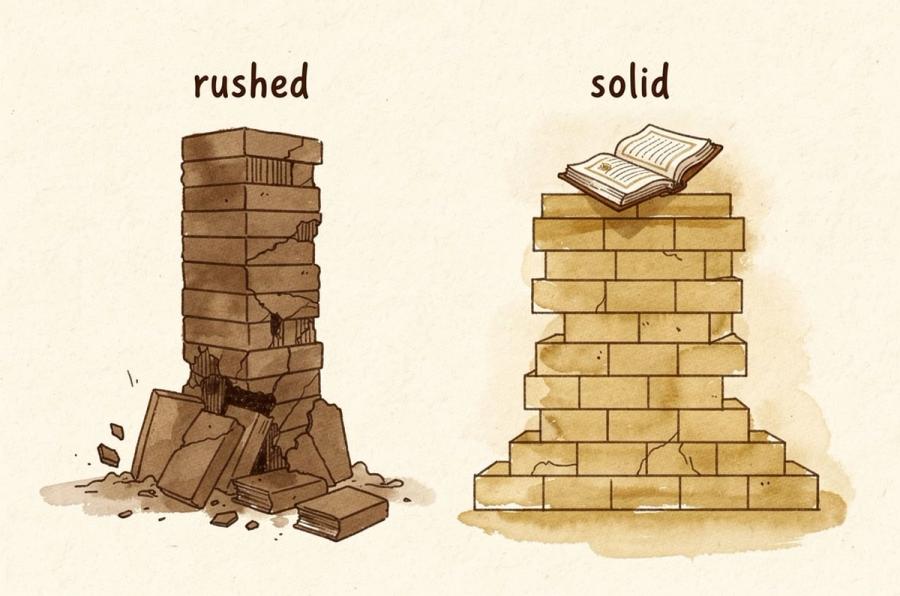
When you miss a day, and you will, do not restart. Just return. The restart mentality is the trap. Missing one day is not a failure. Treating one missed day as a reason to go back to zero is what never finishing actually looks like.
The Mindset Shift That Changes Everything
The Prophet, peace be upon him, said: "The one who is proficient with the Quran will be with the noble and righteous scribes, and the one who recites it and finds it difficult will have a double reward." (Sahih al-Bukhari, no. 4937)
Read that again. The one who finds it difficult gets a double reward. Not a lesser reward. Double.
You are not behind. You are not disqualified. The struggle itself is worship. Every session where you stumble through a page you used to know, and you keep going anyway, that is not failure. That is the very thing the hadith is describing.
Stop waiting to feel ready. Stop waiting for the guilt to lift before you start. The guilt lifts when you return, not before. The Quran is not waiting for you to be worthy of it. It is waiting for you to show up.
Allah says in the Quran: "And We have certainly made the Quran easy for remembrance, so is there any who will remember?" (Surah Al-Qamar, 54:17)
That ayah is not just about ease. It is an open invitation. And it is addressed directly to you, right now, in the exact season of your life where you are reading this.
You have done this before. You know how to memorize. You know what it feels like when an ayah finally settles into your chest. You are not starting from zero. You are returning home.
May Allah make your return to His Book easy, blessed, and lasting. You have carried this longing long enough. Today is a good day to begin. Barakallahu feek.
Build a Routine That Lasts With The Self-Hifz Blueprint
This article is part of our Stay Consistent series. For the full picture, read A Hifz Routine for Busy Adults: A Simple Daily System.
The Self-Hifz Blueprint is our step-by-step guide to memorizing the Quran by yourself, at home, at your own pace. Chapter 28, Common Mistakes That Slow Hifz, covers this in full: seven slowdowns, and how to fix each one.
It includes a daily checklist and a sample six-month plan, so showing up becomes the easy part.
Get The Self-Hifz Blueprint and start your next session with a clear plan.