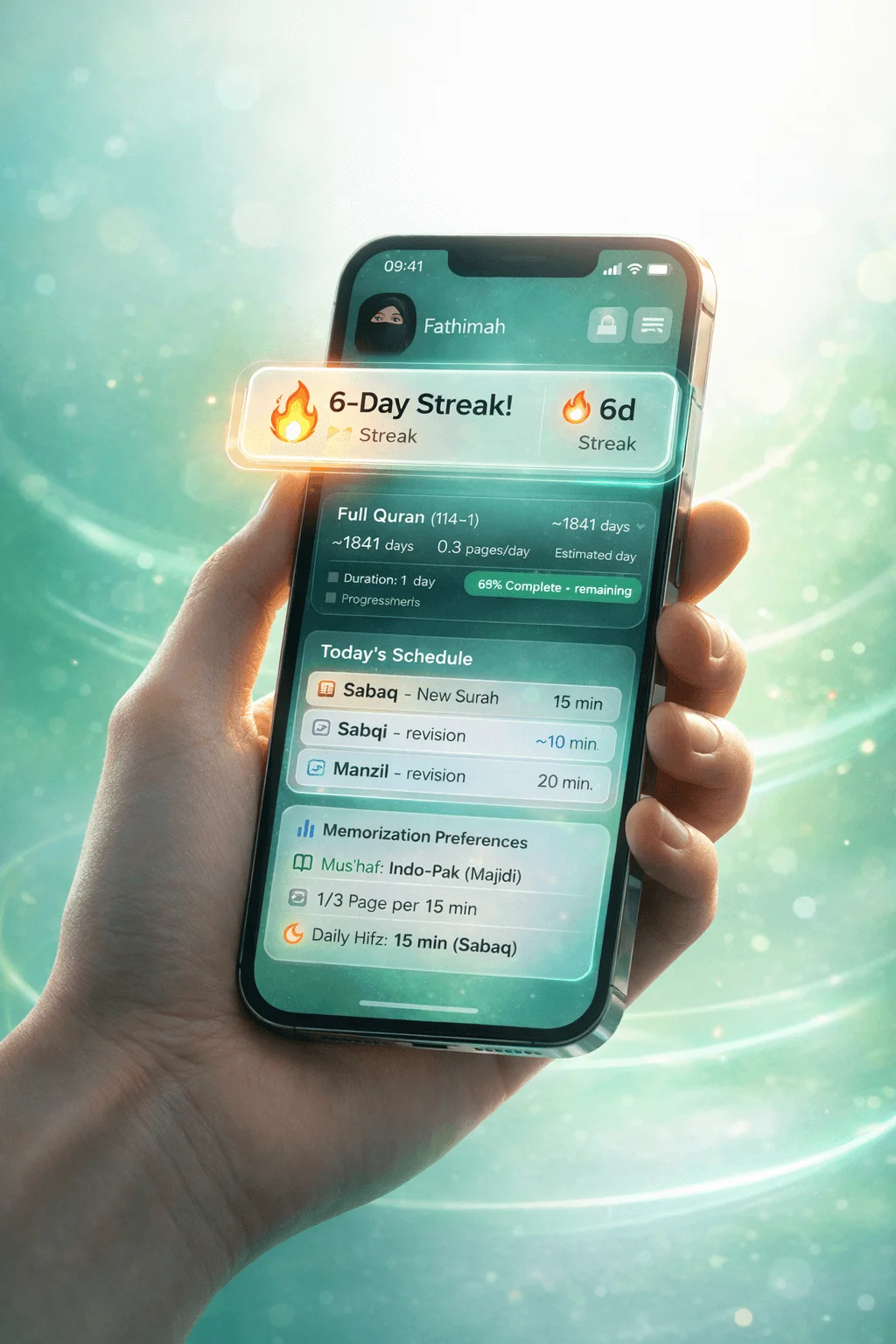
You sit down to do your Hifz. You pick up your phone to open the Quran app. Twelve minutes later you are watching a video about nothing. Sound familiar? This is not a willpower problem. It is an architecture problem. Your phone was designed by some of the smartest engineers alive to pull your attention away from whatever you were doing. And right now, that thing they are pulling you away from is the Quran. The frustrating part is that your phone could genuinely be one of the most powerful Hifz tools you own. The same device that steals your focus can also give you access to a qualified teacher, a recitation to loop, a revision tracker, and a Mushaf — all in your pocket. The tool is not the problem. The setup is. What Your Phone Is Actually Doing to Your Brain During Hifz Memorization requires something called deep encoding. Your brain needs sustained, focused repetition to move an ayah from short-term to long-term memory. That process is fragile. Every notification, every glance at a message, every quick app switch breaks that encoding cycle and forces your brain to start again. Research into attention consistently shows that after an interruption, it takes an average of over twenty minutes to return to a deep focus state. You are not getting twenty uninterrupted minutes between WhatsApp pings. Which means you may be sitting with your Quran for an hour and actually giving it about six minutes of real memorization work. If you have ever wondered why you read the same ayah fifteen times and it still will not stick, this is a big reason. It is not your age. It is not your memory. It is your attention being sliced into pieces before the ayah ever gets the chance to land. If that resonates, the post on why you keep forgetting everything you memorize goes deep on the memory science behind this. The Hidden Way Social Media Shrinks Your Hifz Stamina It is not just notifications in the moment. Scrolling social media before or between Hifz sessions actually trains your brain to expect constant novelty and rapid switching. And then you ask that same brain to sit with one ayah, repeating it quietly, for twenty minutes. It resists. It gets bored. It wanders. This is exactly why so many adults with perfectly good memories struggle to memorize Quran now, even though they did it as children. Back then, your attention was not pre-fragmented every morning by an algorithm. If this clicks for you, the post on why memorizing Quran feels harder as an adult is worth reading alongside this one. The scholars used to speak about the heart needing to be clear and present for Quran to settle in it. Ibn al-Qayyim rahimahullah described the heart that is scattered across worldly affairs as being unable to hold what is placed in it. Fourteen centuries later, neuroscience is essentially confirming the same thing. Allah says in the Quran: 'We will cast into the hearts of those who disbelieve terror as a result of what they have associated with Allah' (Surah Al Imran, 3:151). The principle is the same in reverse — a heart full of other things struggles to hold what is sacred. The Mindset Shift That Changes Everything Stop trying to resist your phone with willpower. That battle is designed for you to lose. The smarter move is to redesign your environment so the default action becomes Hifz, not distraction. Think of it this way. You would not try to memorize Quran in the middle of a loud argument. So why are you trying to memorize it in the middle of an app ecosystem built to compete for every second of your attention? The noisy house Quran memorization post talks about physical environment. Your phone is a digital version of the same noise. The goal is not to throw your phone away. The goal is to make your Hifz session the path of least resistance, and everything else slightly harder to get to. The Practical Setup That Turns Your Phone Into a Hifz Tool Here is a simple system. You do not need a new phone. You do not need an app for this. You just need fifteen minutes of intentional setup. Create a dedicated Hifz folder on your home screen. Put only your Quran app, your recitation audio app, and your teacher or accountability contact inside it. This is the only folder open during Hifz time. Turn on Do Not Disturb with exceptions only for phone calls from your immediate family. No banners. No badges. No sounds. Set it to trigger automatically at your regular Hifz time so you do not have to remember. Delete social media apps from your phone entirely, or at minimum move them off your home screen into a buried folder. The extra friction of finding them is often enough to break the automatic habit. Use a dedicated recitation for your memorization — loop it on your phone while you memorize. Now your phone is actively helping your Hifz instead of fighting it. Apps like those built around spaced repetition for Quran are genuinely useful here. Set a screen time limit on your most-used social or entertainment apps. Make the limit just tight enough to be inconvenient. You are not banning yourself — you are making the path back to Quran the easier choice. Small friction reduces bad habits. Small ease increases good ones. This is the principle behind Kaizen Hifz — tiny systematic improvements compound into real transformation. You do not need a dramatic overhaul. You need better defaults. One Last Thing Before You Move On Shaytan does not always show up as open temptation. Sometimes he shows up as a notification at 8:42am that pulls you out of your Hifz session and then makes you feel too scattered to return. The Shaytan targets Quran memorizers post covers this in depth — it is one of the most important reads for anyone serious about protecting their Hifz. Guard your attention like you guard your prayer. Because in many ways, it is exactly that sacred. Your action step for today: open your phone right now and spend ten minutes doing the setup above. Move the apps. Turn on the schedule. Create the Hifz folder. Do not wait until your next session to prepare for it. Ready to Make Your Hifz Sessions Actually Count? If you are restarting after a break, the hardest part is not the memorization itself — it is finding a structure that holds you accountable without adding more overwhelm to your life. A teacher who meets you where you are, knows your history, and keeps your sessions focused makes all the difference. That is exactly why we built HifzBuddy for adults like you — one-to-one online Hifz sessions with qualified teachers who understand what it means to return to Quran after years away. If you are already memorizing and want to advance faster or lock in your revision before it slips, HifzBuddy gives you a consistent weekly structure and a teacher tracking every ayah with you. No more sessions that drift. No more forgetting what you covered last week. And if you are just getting started and want to do this properly from day one, the right teacher and the right system will protect you from the false starts that steal years. Give HifzBuddy a try this week and see what a focused, guided session actually feels like. May Allah make your Hifz easy, blessed, and lasting. Ameen.
 Tajul Furqan